by Roger Bourke White Jr.
America is famous for transforming new technology into new industry. This is the story one such industry. It is the story of how the local area network industry--the LAN industry--was created during the 1980s in America.
What was accomplished?
Here are some numbers to give you a feel for what these high tech pioneers accomplished.
In 1980 there was no local area networking industry; in 1990 industry sales were about one billion dollars, and the industry continues to grow at 30% to 40% per year.
In 1980 there were about 100 people developing local area networks; in 1990 the largest company employed over 1000 people, and there were five hundred companies working in the industry.
In 1980 many people questioned whether personal computers would ever be useful office tools; in 1990 many people questioned if mainframe computers would ever again be useful office tools.
In ten years the LAN industry was born, grew to billions of dollars, and changed American business' perspective of how to spend money on computers.
My perspective
In 1977 I staked my career on personal computers. In 1981 I joined Novell, one of the pioneer local area network developers, and helped it grow from 20 to 120 employees. In 1982 it shrank back to 20 employees, and I was laid off. In 1986 I rejoined Novell when it had 500 employees, and I helped it grow to 2000 employees. In 1989 I left Novell, this time to work as a LAN industry analyst. I continue to watch Novell and the LAN Industry.
Industry background: Life before LANs
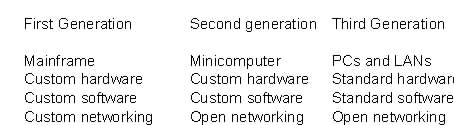
In the middle 1970s business computers were either mainframe computers or minicomputers. Personal computers first appeared in the late 1970s, but they were primitive and suited only for computer hobbyists.
Engineers at mainframe and minicomputer companies looked hard at microcomputer technology, and many used microcomputer chips to build better mainframe and minicomputer accessories. But in the 1970s all these company designers concluded that standalone microcomputers were not powerful enough for business applications. They concluded that the personal computer would remain a toy for at least ten years.
"Personal computers are toys," was the conclusion of the engineers that stayed working for the mainframe and minicomputer companies. But a handful of engineers left these companies, and took with them a different vision of personal computers. They saw personal computers as powerful business tools...if they were connected together in some way. They saw that whoever connected those personal computers would become rich. The tool that would tie these personal computers together was the local area network.
LAN Architecture
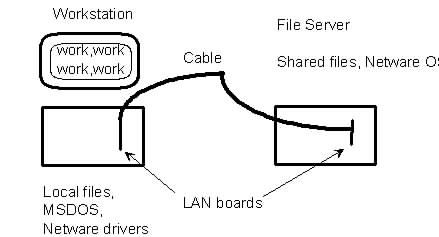
To understand the evolution of the LAN industry, you need to know something about LANs. LANs are a way of connecting standalone computers so that they can talk with each other. This takes cabling, circuit boards and software. Lets take a moment to name the parts of a local area network.
Different visions, different definitions
Before we can define the parts of a LAN, you need to know that the term "local area network" evolved in different places in the computer industry simultaneously. Each place it evolved, the name took on a different meaning. To the engineers at IBM (the largest computer maker in the 1980s), local area network meant connecting mainframe computers using a special cable. To the engineers at DEC (Digital Equipment Corporation, a minicomputer maker, and the 2nd largest maker of computers during the 1980s) local area network meant connecting DEC computers to DEC terminals and DEC printers using a high speed cable.
The definition I will use for LAN comes from those many companies that designed LANs to service the personal computer industry. I use the PC-based LAN definition because in 1994 the PC-based LANs are winning in the race to develop the LAN industry. IBM and DEC service only limited markets with their LANs. Here are the definitions.
Workstation: This is the user's end of a local area network. It is the part a user looks at, types on, mouses at, or talks to. The workstation is a standalone computer, usually a personal computer such as a PC-compatible or a Macintosh. The workstation runs the user's applications programs.
LAN board: this is the circuit board that sits in the workstation and connects the workstation to the cable.
Cable: This is the wire that carries data. It interconnects the workstations and the other accessories that run on the LAN. The cable can be twisted pair (telephone wire), coaxial (similar to cable TV wire), or fiber optical (the newest, the fastest, and the most expensive).
File Server: This is a personal computer running a special program. It doesn't function as a workstation. Instead it manages the shared files of the local area network.
NOS (Network Operating System): This is the collection of programs in charge of running the network operating system. Some of these programs run in the workstations, and some run in the file server. NetWare, made by Novell, is the most commonly used NOS.
These are the basic elements of a local area network.
The first goal of all this equipment is to allow users to share expensive computing resources such as large hard disks, laser printers, engineering plotters, or high-speed overseas phone lines.
The second goal is sharing information quickly. For instance, a local area network moves a document instantly between writers, illustrators, editors and layout people. Updating takes seconds instead of hours or days.
LANs can connect people less expensively, more quickly and more flexibly than mainframes or minicomputers can. This is why LANs have prospered in the United States and started displacing mainframes and minicomputers for many business applications.
Hardware, software and vision
A LAN can be powerful, but it's also complicated. There are lots of parts. There are also many ways of envisioning how a LAN can work. In the 1970s the people thinking about LANs all had different visions of LANs.
Some people saw LANs as hardware. These people thought day and night about how to make the hardware better. One of these people was Bob Metcalf. He developed a signaling protocol called Ethernet, and started a company called 3Com.
Some people saw LANs as software, and thought day and night about how to make the software work better. One of these people was Drew Major. He worked as part of the team that developed NetWare. He contracted to work for a startup company called Novell.
Some saw LANs as a business opportunity. One of these people was Ray Noorda. He saw that East Asian companies, such as Samsung, were going to learn how to make hardware. East Asian hardware would drive down profit margins on American-made hardware. Ray also saw that these East Asian companies would have a hard time learning how to make software. The profit margins in software would stay healthy.
The Big Boys are watching
Ray Noorda and the others that saw the LAN vision were also aware that engineers and planners at the big companies such as IBM and DEC were also watching what they did. When they became successful--when they demonstrated that personal computers really could be office tools--these large companies would start producing similar products. Ray Noorda called this, "Dancing with the elephants." If you stayed nimble, you could survive and make money. If you slowed down, you'd get squashed.
Novell's Story
Making the LAN industry happen was a complicated process. Many people worked together, and competed at the same time, to develop practical products that were valuable to lots of customers. Novell's part in the LAN industry story is important because Novell is a winner. Novell sells 70% of the LAN operating systems used today.
Novell's Time Line
1980 Company founded
1981 Making personal computers and printers, LAN conceived
1982 Crisis: Time of Six Presidents, 1st LAN developed
1983 Ray Noorda takes over; LAN defined, PCs abandoned
1983-86 Educate the market, sell LAN hardware and software
1986-89 Sell software, add "connectivity " to LAN definition
1989 Transform from startup to industry standard company
The vision of Jack Davis and George Canova
Two computer industry veterans started Novell, Jack Davis and George Canova. Neither one was thinking of LANs when they started Novell. Jack was thinking of making minicomputers and terminals, and George was thinking of making computer peripherals and selling them to computer companies who would put their name on the product. This is called OEMing a product.
As these men sought financing, they found a company that was willing to put up six million dollars...if they built a personal computer. "No problem," they said, "the resources you need to design and build personal computers are the same as those you need for terminals, and we're planning to build a terminal already." So Jack and George got financing, and added a personal computer to the business plan.
The vision goes sour: the time of six presidents
One of the people who declined to invest in this early business plan was Ray Noorda. Ray was a friend of Jack's, and they had worked together in the past. But, as I mentioned earlier, he foresaw a crisis looming in the hardware business.
This is an important point: In 1980 Ray Noorda looks at Novell, and declines to get involved. This is important because in 1982 he will look again at Novell, and by 1983 he will be deeply involved. Ray Noorda's actions demonstrate one of the great strengths of the American business system; it's flexibility and adaptability.
George and Jack built up their company throughout 1981. They leased buildings and equipment and hired 120 people to start making and marketing printers and personal computers. George and Jack had created a startup company. Note that what they are building--personal computers and printers--is not the terminals and minicomputers that were written up in the business plan. The printer and the personal computer have come first, not the terminal or the minicomputer. But this is not a great concern to the investors because startup companies are notoriously flexible. The investors are investing in the ability of the managers to adapt as much as they are in their ability to write a business plan.
By the fall of 1981, however, there was trouble at Novell. The company had all the expenses of a successful startup company, but the sales were much less than forecast, products were coming out late, and when they arrived they were selling poorly. Using up money with little to show for it had investors concerned, and they acted by sending one of their directors to investigate.
The director talked with George Canova, the president. He said the problem lay with Jack Davis, his partner, and asked that Jack be let go. Jack left, but that didn't turn the company around. The company was still losing money and three months later George Canova resigned as well.
Ray Noorda to the rescue
During 1982 Novell was in serious trouble. The founders were gone and the company was losing money every month. All the investors had was a dream, but that might be enough. Novell was in the computer business, a business with endless possibilities. While the company was collapsing around them, four engineers in the back room were busy developing local area network software.
LAN development at Novell started as a stop-gap--a way to improve the salability of the personal computer. But when sales of the printer and personal computer failed to develop, it became clear to the managers and investors that LAN software was Novell's big hope for the future.
The challenge for 1982 was how to transform this dream into a profitable product. This meant keeping Novell alive somehow, and 1982 became what I call "The time of six presidents."
The time of six presidents was a messy, uncomfortable time for Novell. The company shrank from 120 people to 20 people. There was lots of chaos, backbiting and finger pointing. There was a month when sales was actually negative--more goods were returned than sent out. There were five different people declared president between June and December of 1982, and the company was even sold once--to a man who agreed to buy it but never showed up with the down payment. It was Novell's Long March, but unlike the Chinese Communist Long March, no one talks about it much anymore at Novell.
While all this was going on, Jack Davis was still active. He talked once again with Ray Noorda. He said, "Ray, you're good at turning companies around. Take a look at this one." He told the investors about Ray saying, "This man is a company doctor. He fixes companies, and this is what Novell needs."
In November Ray visited Novell's trade show booth at Comdex, and in January he invested in Novell and assumed control.
Picking gold nuggets from the ashes
Ray's first job was to pick the gold nuggets out of the ashes, and bury the rest. He wanted the LAN, not the hardware. He wanted the people who shared the LAN vision and would work hard for that vision, not the finger pointers and politicians. By April only the fifteen "founders" remained, and the printer, terminal, minicomputer and personal computer where history. The only hardware remaining were the LAN boards and the file server.
Vision in the face of harsh reality: moving from hardware to software
In 1983 Novell's destiny was far from clear to investors and outsiders, but the team within Novell had figured it out. LANs were starting to spark a lot of interest. There were at least 24 companies building LAN boards now, and the time when Novell or any other single company could provide LANs for the world was gone (if it had ever existed). What Novell could provide was a superior operating system. The other companies were concentrating on hardware.
Novell's extraordinary vision was to realize that all these hardware makers would need a "glue" product, the LAN operating system, to make them work better.
From 1983 on, Novell concentrated on designing a superior LAN operating system, and devising the best ways to market it. The marketing challenge was just as great as the design challenge because many people had to be pleased with Novell and NetWare. End users had to be pleased, LAN board manufacturers had to be pleased, and distributors had to be pleased. In addition to being pleased, all these people had to be aware that NetWare existed, and that using it would be beneficial. The marketing task was a giant one.
Profits in the face of harsh reality: staying with hardware
NetWare, the operating system, would make Novell distinctive, but in the middle 1980s there wasn't much money to be made in operating systems. Some people in Novell declared that, "Novell was a software company." Others said, "It's fine to say that, but look at what products are paying for your salary." The first versions of NetWare sold for about $500, and the gross profit on that was about $400. Novell sold its file server for about $4000 and made about $2000 gross profit.
This "hardware versus software" dispute was one of many rivalries within Novell. But Novell's top managers during the middle eighties were all veterans of the time of six presidents. In spite of their differences, they cooperated and Novell serviced its market effectively. Novell grew.
The growth of the mid-eighties
Throughout the 1980s the LAN market grew explosively--it averaged about 60% growth per year. The hardware vendors competed and prices for LAN boards halved about every year throughout this period. Each price reduction opened new markets, and each new market increased the need for LAN software. The hardware vendors grew, but Novell grew even more because it became an industry standard, much the same as MSDOS became an industry standard for PC-compatible computers.
Competing and Cooperating: Novell, 3Com, and Microsoft
Throughout the 1980s LAN industry companies competed and cooperated simultaneously. The companies of the industry competed fiercely by bringing out new products. The companies cooperated fiercely by making every product "backwards compatible" with existing products and "cross compatible" with other industry products.
The companies cooperated because their customers saw compatibility as a major benefit in buying a LAN. Minicomputer systems didn't offer this feature. Only one vendor built each kind of minicomputer component. Minicomputer customers were "locked in" to a single supplier. Many customers were uncomfortable with this. They tolerated it only as long as no "open" alternative was available. When LANs offered an open alternative--one where many suppliers could make compatible parts--many former minicomputer customers came flocking.
Here is an example of the complex interactions between LAN industry companies. In the mid-1980s 3Com was the largest producer of Ethernet boards, Novell was the largest NOS producer, and Microsoft PCOS producer. These companies cooperated: Microsoft put "hooks" in MSDOS to support networking. Novell supported those hooks in NetWare, and Novell supported the 3Com boards with NetWare.
These companies also competed. Microsoft sold a network operating system called LAN Manager. 3Com bought LAN Manager and developed the drivers to make LAN Manager work with 3Com boards. They then enhanced LAN Manager by adding features, and sold it as an alternative to Microsoft LAN manager and NetWare. Novell sold LAN boards.
Competition and Cooperation
Novell...
Competes with Microsoft by offering NetWare NOS
Cooperates with Microsoft to make MSDOS work with NetWare
Competes with 3Com by selling LAN boards
Cooperates with 3Com to make NetWare drivers for 3Com boards
Microsoft...
Supplies MSDOS and Windows
Competes with Novell by offering LAN Manager NOS
Cooperates with 3Com who customizes LAN Manager
3Com...
Competes with Microsoft by offering improved LAN Manger
Splitting the vision: the "Palace Revolt" in 1988
Throughout the 1980s Novell did many things right. The company grew to thousands of people. But sucess brings it's own challenges. Success was hard on the fifteen founders. As the company grew, their influence waned. One by one they left, and a dozen professional managers replaced each. These new managers came to Novell with experience gained in other parts of the computer industry. Many came from the minicomputer industry where they could see the writing on the wall--LANs were replacing minicomputers as the office computer in American business.
These new people brought with them new ideas...well, not new ideas. New ideas to Novell, but old ideas that they had developed while working in the minicomputer industry. The change in size and the new ideas these people brought caused a lot of friction with the older employees. The older employees understood competing and cooperating. The older employees enjoyed being the first to do something. They relished the fact that Novell was a pioneer in creating the LAN industry and they want to continue this task of defining the LAN industry, or find something new to define. The newer employees came to Novell because the product that these founders had created was meeting the needs of the market. They were at Novell to work with Novell's existing concept of what a LAN was, not to create some whole new concept again.
This friction reached a flashpoint in 1988 when two of the last founders called for Ray to resign. They said Ray was no longer leading the company to new markets. They said Novell was abandoning its role as an industry creator. This was a harsh act because over the years these people had become close friends of Ray's as well. But Ray was in full control of the company, and he forced them out instead. Their departure was the signal that Novell was no longer a startup and would no longer be in the business of creating new industries. It would, however, remain a very profitable company, and it would service its customers well.
Transforming to a mid-size company in 1989
In 1989 Novell transformed into a "Statue of Liberty" company. It became a fine company, a nice company, a company to inspire many others...but it didn't move much. NetWare was Novell, and Novell was NetWare. Novell remains a profitable company to this day. It is servicing its markets well and it is growing as more and more people need the features that LANs offer. But Novell is no longer in the business of creating new industries. It's now the time for ex-Novellers in new companies to do that.
That's the end of my story of Novell. Now, what can we learn from that story? What makes developing a high tech industry distinct from developing, say, a ship building industry?
Disposing of the dead bodies
Creating a new high tech industry is a horse race. There are many players; a few winners and a lot of losers. Losers names litter LAN history: Nestar, Corvus, Orchid, 3Com, Data General, Xerox, DEC, and 10Net are just a few of the companies that made products for the LAN industry. Some of these companies have disappered completely. Others survive, but they no longer make LAN equipment. Others survive making LAN equipment, but they service only niche marketplaces. People quickly forget losers, but in reality they're the most important part of the industry. These are the organizations that have showed us what won't work.
What happens to the people working for the losers? They join the winning companies, or move on to create new industries. In the societies of emerging industries the organizations are perishable, but the people endure. This is the opposite of the military, the church, the government, or heavy industry where people perish and the organizations endure. In 1982 Many people from Novell went to Icon Research and Beehive International. In 1986 many people from Beehive International went back to Novell.
The strength of the American free market system is not so much it's ability to pick winners as it is its ability to quickly and efficiently dispose of losers.
What can government do?
Can government agencies pick high tech winners? Yes...as often as businessmen can. The difference is not in picking winners, it's disposing of bad choices. The great advantage of business over government in an information age world is it's ability to respond quickly to signals of failure.
The "heavy" in heavy industry refers to the financial burden it takes to launch a project. The "high tech" in high tech industry refers to the communication and knowledge burden it places on launching a new project. Governments are about as good as business in raising money, but thus far they have fallen far short in their ability to move information quickly. This is why business has proved so much better adapted to high tech projects, and why American business seems particularly well adapted.
What can governments do? In the short run they can stay out of the way. They can promote an environment that is conducive to creating small business organizations, and they can insure that small organizations have equal access to the hundreds of opportunities that open up every day in every nation. Once that is done, governments can stand back and let the business people do the leg work finding out how each organization will best fit.
What governments can do in the long run depends on technology. As governments and companies learn to move information quickly, or when developing a new industry calls for more emphasis on finance than knowledge, then governments can perform as well as business at developing industries. The faster paced the industry, the better suited it is to being developed by small businesses. The more financially demanding and standards-oriented an industry is, the better suited it is to being developed by a large business or government institution.
What is there to learn about creating new industries?
The growth of Novell and the LAN industry is an example of the growth of a high tech industry in the United States.
Note that this creating of an industry is an intellectually messy process, but an intellectual process nonetheless. Many business plans are made, but few are followed through as they are created--there are lots of distractions along the way.
Note that much of what is happening as the industry is being created is the business of defining. At the start of creating an industry there are many concepts advocated and many ways that different components within the industry can interact. Much of the research and development effort spent at these startup companies goes to defining how things will fit together. Much of the marketing effort goes to educating the public on what has been defined. Throughout this process there's a lot of feedback between all parts of the company--it takes a lot of communicating to create a new industry. This is why a small company has an advantage, and it is this business of defining and communicating intensely that attracts pioneers to a newly emerging industry.
As the industry grows, it becomes better defined. As the industry becomes better defined, standards emerge. Standards are a substitute for communication. As standards go into place, the industry no longer requires as much communication to function efficiently. Standards allow economies of scale to become more important than rapid communication, and a larger company can function more efficiently than a smaller company.
As the industry evolves away from requiring intensive communications, the people who are attracted to the industry will change, and the culture within the surviving companies will change.
Government can help by understanding that when it is dealing with a high tech industry and high tech companies, it is dealing with a fast changing beast. These companies need to move fast, and their nature will change daily. Government can help by keeping up or keeping out of the way. Government can hinder by slowing things down or by saying, "The way we did this yesterday worked fine yesterday, why shouldn't it work well today?" In the high tech world yesterday is ancient history. Today brings new challenges, and new solutions.