Questions
Background comments
Getting good teachers for JAFLI is a filtering process. Many Americans think about coming to Korea to teach English. (Most of those think of coming to Asia, actually, with Japan or China or Korea being equally suitable.) Of the many that think of coming, a few take the plunge. Those that do take the plunge come for a couple of reasons: first, they are curious and second they have only weak commitments keeping them in the US.
Of those that come, some will stay the length of the tour, and a few of those stay for another year. Finding stable teachers for JAFLI is a great sifting process, and sifting is an expensive process. Each crisis is expensive in time, money and reputation. The challenge for you and JAFLI face is to make this recruiting process more predictable and less crisis-filled.
Can that be done? Can the process be made more predictable? Perhaps. Lets look more at why Americans come to Korea, and why they stay. If this analysis proves successful, there may be alternative ways to hire teachers that produce higher quality, more stable teachers that the current method attracts.
The basics of teacher selecting
Finding a teacher for JAFLI currently consists of the following:
But there is more. The challenge you face at JAFLI is two-fold:
Getting good teachers
I've been here a while now. It seems that many of the long term teachers at JAFLI are people that would have trouble keeping work in America. Heavy drinking, publically violent temperment, medical problems and undereducation are serious handicaps to job finding in the US. Some of the teachers here have a love-hate relation with Korea and JAFLI. They don't like it here, but they've got little to return to in the US, either.
A new kind of teacher
Misfits are one kind of teacher that will come to Korea. But what you want--what will make the best teachers for JAFLI--aren't misfits, but reliable people who are here for adventure. These kinds of people are, ironically, the UCSB people. The UCSB teachers are clean-cut Americans who can go back to America and get good jobs.
For whatever combination of reasons, their experience here in Korea ceased to be as attractive as returning home to jobs in the US.
If you want to attract clean-cut Americans, you need to look at the basic reasons behind the UCSB teachers' departure, and see if the basic problems can be corrected or compensated for. If they can be, then the quality of teachers you can attract will improve dramatically and the number of crises you face will decline dramatically. The alternative is hiring more misfits, and hoping some will find Korea more hospitable than the United States.
The following are some things to consider.
The pay people receive from JAFLI
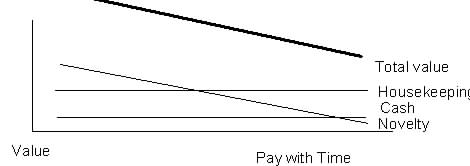
First, lets look at money, heart of all commercial relations, and teaching English in Korea is a commercial relation. The pay you are offering Americans for teaching English in Korea consists of three parts: housing, cash, novelty.
Housing is the apartment and all the assistance you and your wife and Miss Kim give us to do the basics of living in Korea. This includes all the paperwork you process to get us and keep us here, the class scheduling, arranging the classes, and the dealing with the landlord and utility companies. Much of this pay is invisible to the teachers. I don't see the paperwork or the time on the phone, and I can't eat it. It's a cost to you, but many times it is not a tangible benefit to me.
Cash is the money I receive for teaching. This I can see and measure. This is what the contract covers.
The third component of a teacher's pay is the novelty of spending time in Korea and learning about Korea. Novelty is the experiences a teacher gains while teaching. Things such as talking with students about Korea and the opportunity to sightsee Korea in depth.
This novelty payment is intangible but extremely valuable. You aren't paying enough cash to attract good English teachers, it's an American's feeling towards this novelty payment that determines who will come to Korea, and who will stay for a second year.
The problem is that the novelty of the Korean experience declines in value, unless specific steps are taken to keep it high. If a teacher stays contented in Korea, it's because some compensation for the declining novelty value has been found.
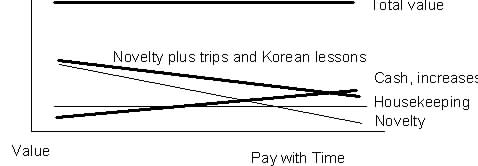
Some things that can replace it are:
A teacher that stays, a good teacher that stays, will have found something that compensates for the decline in novelty value of the Korean experience. If you can make this process happen more predictably, then you will have less crises and you will be able to attract better quality teachers.
Other compensation problems: "Cheap shots" and the "Squeaky Wheel Bonus"
Communications in business are difficult even between native English speakers. Communications with Americans in Korea must be watched constantly, and it must not appear that JAFLI taking advantage of the American teachers.
Here's an example of when the American teachers thought they were being taken advantage of: The contract states that a class hour can be from 50 to 70 minutes long. In the United States most class hours are 50 minutes of class and 10 minutes of break (50/10). From my conversations with Korean students, the standard class length in Korea is also 50 minutes of class with 10 minutes of break. When JAFLI started running mostly 70 minute classes, and charged students more but didn't pay teachers more, that was taking advantage of the teachers. It felt like a "cheap shot" was being taken by JAFLI against the teachers and the students.
The Squeaky Wheel Bonus
The most upsetting part I have with my JAFLI relations is watching you pay a "squeaky wheel bonus." From the American perspective, it often looks like politely presented complaints are ignored, but yelling and shouting gets things accomplished. There is a proverb in America that "the squeaky wheel gets the grease." hence when you respond better to a bitterly complaining American than a politely complaining American, you are paying a squeaky wheel bonus.
If you're paying a Squeaky Wheel Bonus, it says that if I stay quiet, if I support you, I'll get less than if I complain or cause a modest amount of trouble. This I find really upsetting. I was raised and trained to support my boss. I was raised and trained that if I support my boss, I'll get support from him. But it's hard to follow that training when I see a "nice guys finish last" situation developing.
Is there a problem with the JAFLI offering?
The UCSB teachers are good, fresh workers who will be good, fresh workers in the US. The fact that you're having trouble retaining them means that the JAFLI Korean experience has not been suitable for an average American worker coming out of college. If this is true, you're cutting yourself off from the biggest market for American English teachers and you need to be sure that's what you really want to do.
If you want to retain higher quality teachers, you will have to change what you are offering. There are higher quality teachers to be had, but what you offer them will have to be different.
Keeping the teachers satisfied
Making the stay at JAFLI pleasant is important. IT'S IMPORTANT! There's a proverb in retail marketing: "A satisfied customer will tell one other person he's satisfied. A dissatisfied customer will tell ten others what a jerk you are." A failure, a teacher who leaves with bad stories, will spread bad news about JAFLI a lot further and faster than a teacher leaving with good stories to tell. American teachers are JAFLI customers just as much as paying students are. They must be satisfied with their experience.
So, how can American teachers be serviced better? Perhaps by changing the perspective of what JAFLI is offering to American teachers. Perhaps by formally recognizing the novelty pay, and making a stay at JAFLI half-teaching and half-touring. Here are some specific ideas.
Alternative offerings
First of all, you need to know more about your teachers. Americans are a varied lot. They come for many different reasons, and they will be pleased and irritated by different things. The really important thing is to stay in communication with your teachers. If you stay in touch. If you understand what is being thought. You can head off crises like these before they get so severe.
So first, I would suggest a monthly meeting or a monthly interview with your teachers. This will be a time to hear what's happening and what's a problem. Listen to what you hear. The roots of today's crisis were in the wind 60 days ago.
Second, recognize that a lot of what you are paying to American teachers is novelty value. The best American teachers aren't coming strictly for the cash, they're coming for the experience. If the experience is a good one, you'll attract more good teachers. If you have more Mormon/UCSB experiences where the teachers leave early and unhappy, the quality of the teachers you attract will decline fast. If, on the other hand, you have happy teachers going back to the US, then you'll get quality recommends from those who return your applicant pool will improve in quality.
Here are some ideas that might attract more people like myself:
It was also an insult, by the way, to not be able to juggle my schedule so I could get an extra day for a vacation around Memorial Day this month. Americans are used to two weeks of paid vacation every year from the start of a job, and more after longer employment. It is disturbing for me not to be able to take off two days, without pay, after giving one month notice.
A new Marketing Program for JAFLI teachers