
|
Jim Lewis goes into the Army, and my work in WWII After WWII, I venture into fiberglass, Marrying Mike, and my heart problem Getting Dick Newpher to join me at Glastic
|
After that training stint in Jersey City, I was sent to the Cleveland Regional Office. The manager there welcomed me, and, to help me get settled in, told me about a group of young single men who were spending the summer months at a Lake Erie shore side home in suburban Bratenahl. I joined them. Shortly thereafter, I came across an ad about a sailing kayak kit which I realized could be assembled there at our summer house. I bought one, and I assembled it there. When it was finished I often took one of the others for a ride out on Lake Erie next to our home.
This was great fun, but Lake Erie is infamous for sudden storms that blow up rough waters. These rough winds and waves were devastating to the kayak, and it fell apart after a few weeks. I put my engineering degree right to work: I was eager to design and build a kayak that would be strong enough to withstand the Lake Erie winds and waves. Fall soon arrived and when the other fellows started returning to their winter homes, I decided to find a place where I could spend my free time designing and building a proper kayak. I found and rented another house on the lake shore, and I got some other young single guys to come with me. This made the cost of rent and a housekeeper lady reasonable for each of us. Then I got to work in my spare time on the design and building of a sturdy sailing kayak.
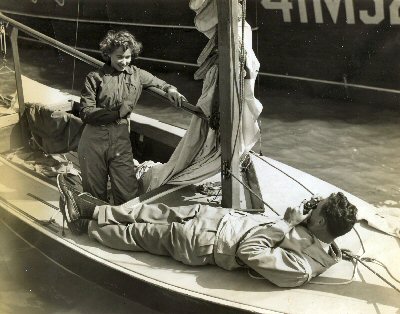
I had a good friend, Dick Newpher, who was married and not able to move in with my group of young single guys. But he liked the kayak idea, and we worked together almost every evening building two such identical kayaks. We worked together on this project almost every evening. Dick's wife did not much like his being away from home all those evenings, but it did not break up their marriage. We had our Kayaks finished by early the next summer and we took them out on the lake. We were delighted with their sailing behavior. One Sunday morning we sailed in our kayaks east up the coast about five miles to a large sailboat club at Mentor Harbor. We found that our kayaks could sail rings around the conventional sail boats which operated out of the harbor there.
We joined the club. We had great fun with our kayaks, and some of the other members built similar kayaks. We all had lots of fun. Two years later Dick and I each got a larger racing class sail boat (an I-21) which we kept at Mentor. We raced there every Sunday against a dozen others. Dick devastated me. He would win these races frequently. He almost always finished ahead of me, often ahead of all the others and in first place.
|
Roger at the "Gold Coast." (1944) |
|
Roger with his I-21. (1944) |
My first Linde assignment in Cleveland was to go to all the steel mills in Ohio and Pennsylvania to demonstrate to the mill managers a new Linde "torch". The torch was an oxy-acetelene torch used to cut out defects in ingots. Ingots are the first stage in the production of flat steel plates of various sizes and shapes. They are big fellows: 3x3x8 feet in size. Most of the steel's impurities will migrate to the surface of the ingot as it cools, so cutting out surface impurities improves the steel's overall quality dramatically. The ingots are inspected for impurities, and, under the old system, the impurities would be chiseled out with jack hammers. Under the new Linde system they would be burned out with a torch... much easier and cheaper.
One of Linde's customers in Cleveland was an industrial overhead-crane manufacturing company. When I called at this factory I met Mr. James Lewis, the plant manager. He told me that he was about to leave his job there because he was going to start up a business of his own. It would be called Lewis Welding Inc. His new business would be to design and manufacture welded steel machine parts -- an example was replacing the expensive, heavy, cast iron blocks then used for counterweights on road building equipment such as steam rollers and cranes. Lewis Welding would able to replace these blocks with a welded steel hollow shell, which could then be filled with inexpensive large rocks. The result was a much lower cost counterweight than those using huge, expensive, cast iron blocks.
I had always planned to start a business of my own, but I knew that I must first get a lot more experience. I said to Lewis, "I'd like to work for you. Pay me whatever you choose". He hired me on the spot, and he paid me a generous salary.
While working for Lewis I called on the Chief Engineer of a printing press company in Cleveland. When this fellow heard my name he cocked his head quizzically and said, "You're Roger White?"
I said, "Yes sir."
He stared at me for a moment and said, "Was your father Joseph White?"
I was quite surprised at this but I said again, "Yes indeed, sir."
He practically jumped down my throat. He said, with the greatest respect, "Your father was the most prolific inventor I have ever known. He and I were eye-to-eye competitors in devising improvements in printing press design."
This had me glowing with pride and I then had little difficulty getting from him an opportunity to design and quote welded steel structures to replace his current very heavy, very costly, cast iron structures, which I was sure we could make for him at a much lower cost.
He said "Let's see".
I put together a design of what we could do and quoted a price. He promptly gave me an order to proceed with this very substantial project. He knew he would be taking a chance and I knew that we would not collect a dime if he was not entirely satisfied with the job we were to do. He gave me drawings of his present structure and I went to work, with the greatest of care. We delivered right on time. Our product passed with flying colors and we got paid immediately. This fed our larder just in time to keep our new startup company from going broke.
|
Jim Lewis goes into the Army, and my work in WWII After WWII, I venture into fiberglass, Marrying Mike, and my heart problem Getting Dick Newpher to join me at Glastic
|